Rhiannon Callais features editor
Murder always gets attention; always gets the headlines. In 2024, almost 20 million Americans listened to a true crime podcast in an average week, according to Edison Research. But coverage rarely explores the communities and people affected by these murders.
This issue of Lost Bayou shifts the focus. Looking beyond the files, beyond the headlines and beyond the murders.
Measuring Loss
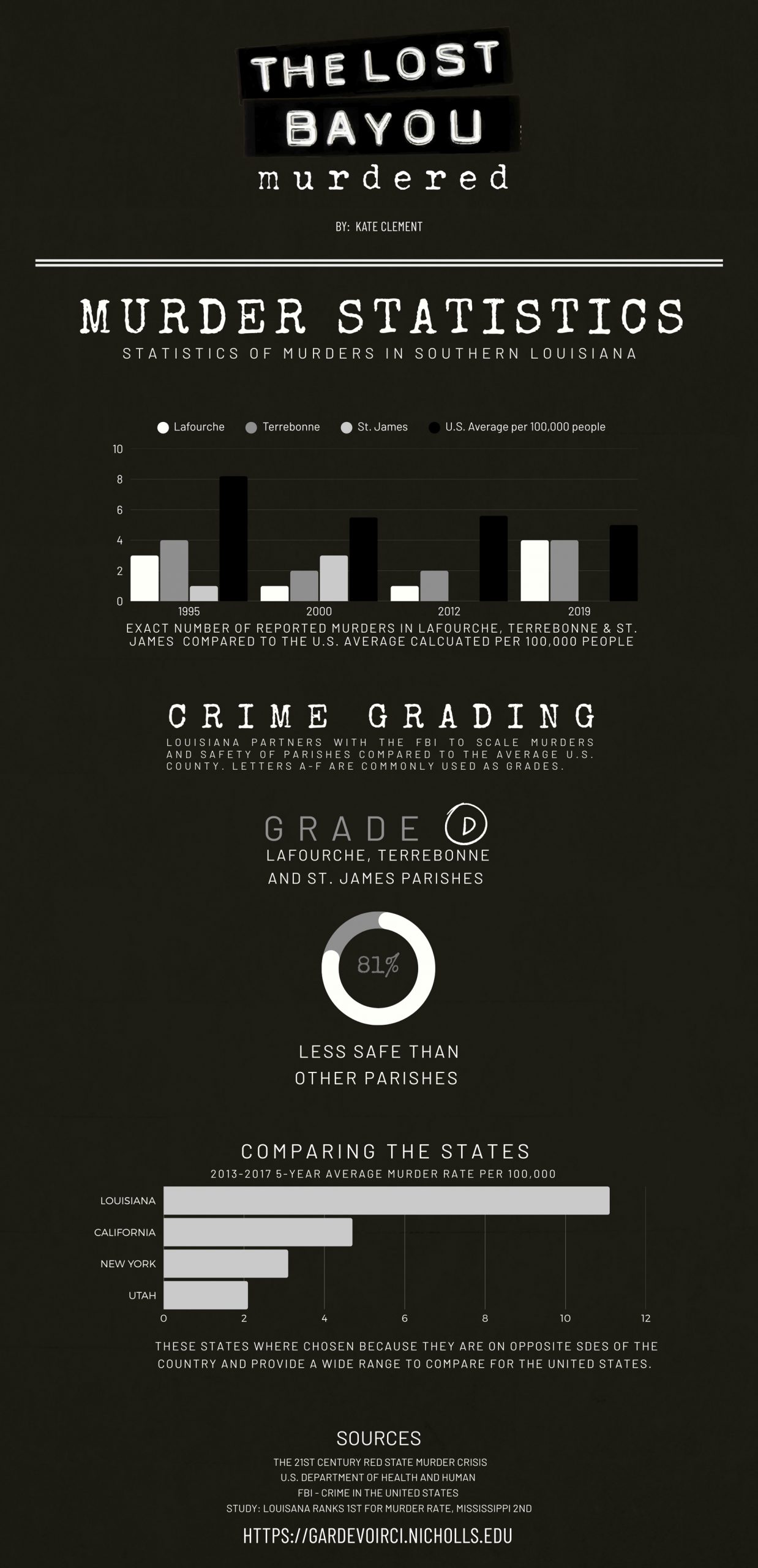
Louisiana has long been known for high homicide rates.
In 2023, the state ranked second in the nation for murders, with 17.8 deaths per 100,000 people, according to America’s Health Rankings analysis of the U.S. Department of Health.
Homicide is also the 10th leading cause of death in the state.
The FBI ranks parish safety on a letter scale from A to F. Lafourche, Terrebonne, and St. James parishes are 81% less safe than the U.S. average, earning a D rating.
Each number represents a life lost and a community forever changed.
A name beyond a headline
Joycelyn Terrebonne understands this loss firsthand.
She lost her grandmother, Enola Boudreaux, 73, to murder on June 22, 1995.
When people think about Enola, they think about the news coverage in local papers. Terrebonne says people ask about the details about her death; not her life
Born into poverty, Enola left school in the second grade to help raise her siblings. She hummed lullabies to her grandchildren, even if she couldn’t carry a tune.
The day her grandmother went missing, Terrebonne says she felt it before she understood it.
“I knew something was wrong,” she says. “I think it was the Holy Spirit telling me, but I knew something was wrong.”
Enola was killed inside her home, Terrebonne says the shock was impossible to process.
“It was like we were in the Twilight Zone,” she says. “It’s like living out of your body. You’re living a nightmare”
For Terrebonne’s family, the story did not end with police tape or an investigation; it became a loss that continues today, more than 30 years later. A loss felt in the everyday moments only a family bears and can understand.
“It was like we were in the Twilight Zone. It’s like living out of your body. You’re living a nightmare”
Joycelyn Terrebonne
Thibodaux Massacre
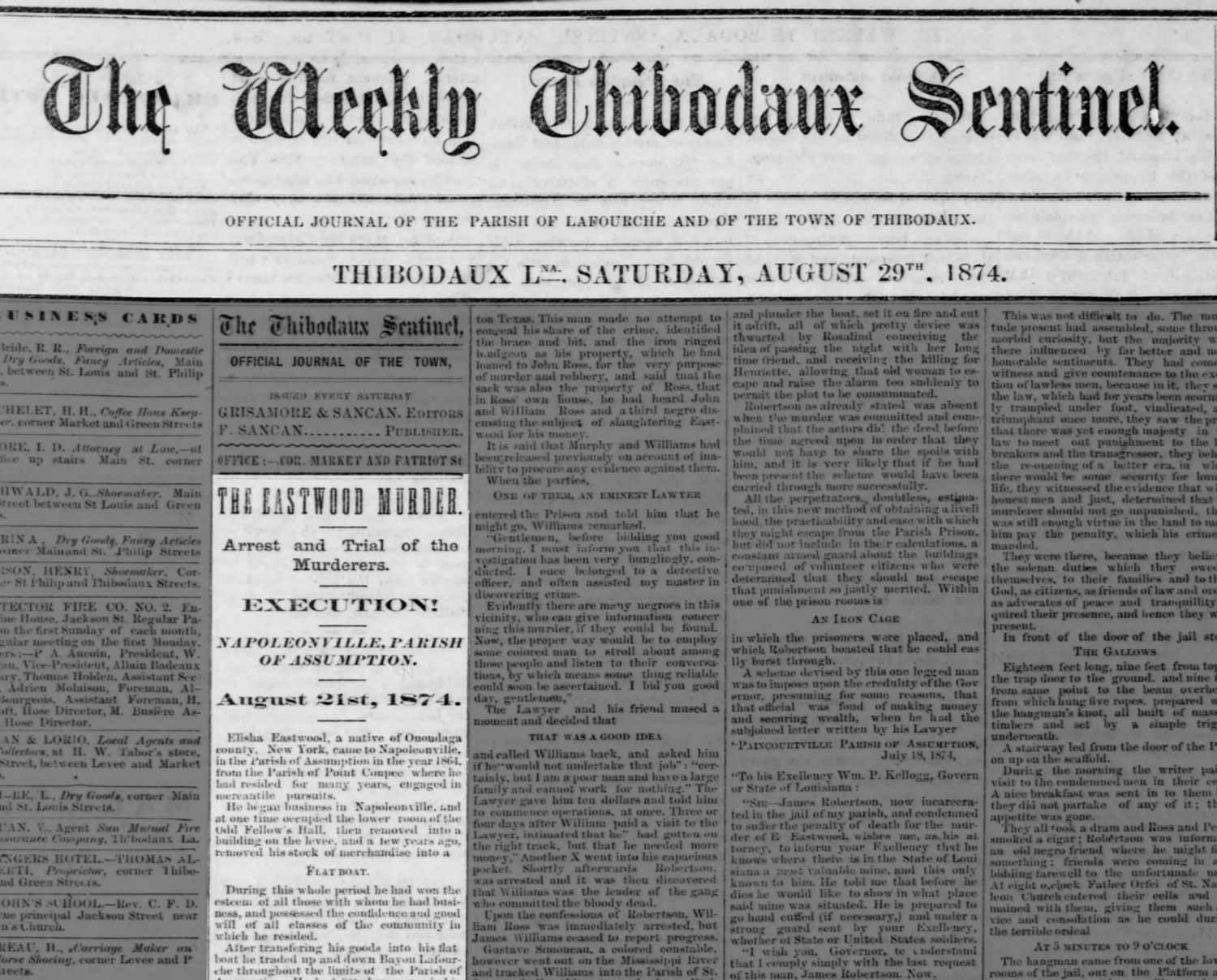
Murder has always been a part of Louisiana’s history. The 1887 Thibodaux Massacre was made famous by a book published in 2016 by John DeSantis.
DeSantis estimates 30-60 mostly African-American sugar workers were killed after a three-week strike for better wages across Lafourche, Terrebonne, St. Mary, and Assumption parishes.
Military forces went house to house, killing workers and their families, says DeSantis. Survivors fled to the swamps, and bodies were dumped in unmarked sites.
Historical coverage describes the unrest, the political tension and the aftermath. However, much less is said about the individual lives lost and the families left behind.
Descendant of multiple victims, Wiletta Ferdinand, says the massacre still affects her family today, 139 years later.
“When you learn this kind of stuff, for people who you carry that same genes, that same blood, of course, you feel hurt, devastated,” Ferdinand says. “They didn’t even have a gun. They weren’t even armed. It’s a very sad situation. And of course, you feel like you lost a loved one.”
Murder coverage today
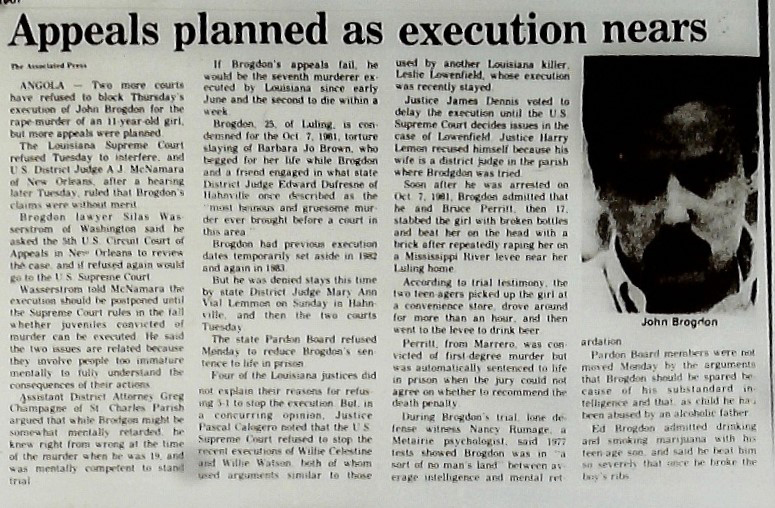
As newspapers gained popularity in the 19th and 20th centuries, murder coverage expanded. Today, journalists still wrestle with how to tell these stories. Colin Campo, a journalist working with The Houma Courier, says covering a murder rarely has a clear beginning or end.
Campo says families are one of the primary sources of information, yet reporters often arrive while they are still in shock.
“What you want to do is put the ball in their court,” Campo says. “You don’t want to cause them more pain. That’s the last thing you want to do”
However, once cases go to trial, coverage often shifts. Victims’ families are encouraged not to speak with the media, and the story focuses more on the suspect than the loss.
Over time, victims fade into the headlines and gossip, remembered only for the crime and not for their lives.
Terrebonne says the murder of her grandmother still feels impossible to understand, even decades later.
“When you go through something like that, things don’t pan out right in your mind,” Terrebonne says. “It’s so shocking. Who thinks they’re going to go through something like that in their family? Nobody.”