Crafts Showcase Artistry

By loryn monceaux By troy dupont
Foods and Influences

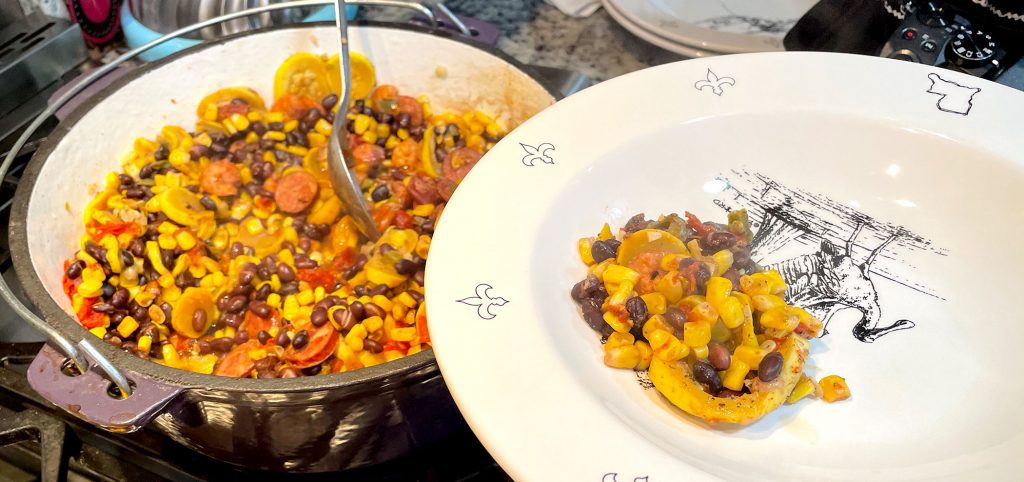
By Robbie Trosclair, staff writer For the United Houma Nation, food starts with traditional crops like corn, squash and beans — a trio known as the three sisters because of the way they sustain each other and the soil while growing together. Monique Verdin, a UHN member, believes the food they grow is important to help heal the damage done to the Earth from overfarming. “We should look down at the earth beneath us in order to look forward,” Verdin said. With the crops grown, the UNH can start to celebrate their history by creating traditional foods. Ida Aronson, who runs the United Houma Nation farm, says growing traditional produce is helping them connect to their past through traditional recipes like Maque Choux (pronounced Mock-Shoe), a recipe made from corn and herbs. Other traditional dishes include dumplings made from persimmons, custards made from squash and traditional teas. “I’m hoping to bring back more nutritional foods to the surrounding Houma area,” Aronson says. Louise Billiot, who grew up with indigenous dishes like the ones above, says another traditional dish she grew up with is fry bread. “It’s simplicity is why it’s so good,” Billiot says. Billiot says that when she was a child growing up, she remembers the cooking being plain because they didn’t have much. Even her gumbo recipe just consists mostly of onions, chicken, water and filé, a thickener used in gumbo made from ground sassafras, a traditional UHN crop. In fact, the Houma introduced many ingredients that are now considered Cajun — foods like grits, sweet potatoes and beans, she says. A community farm Cooking With annie’s restaurant Recipes & Foods
The Musical Backdrop

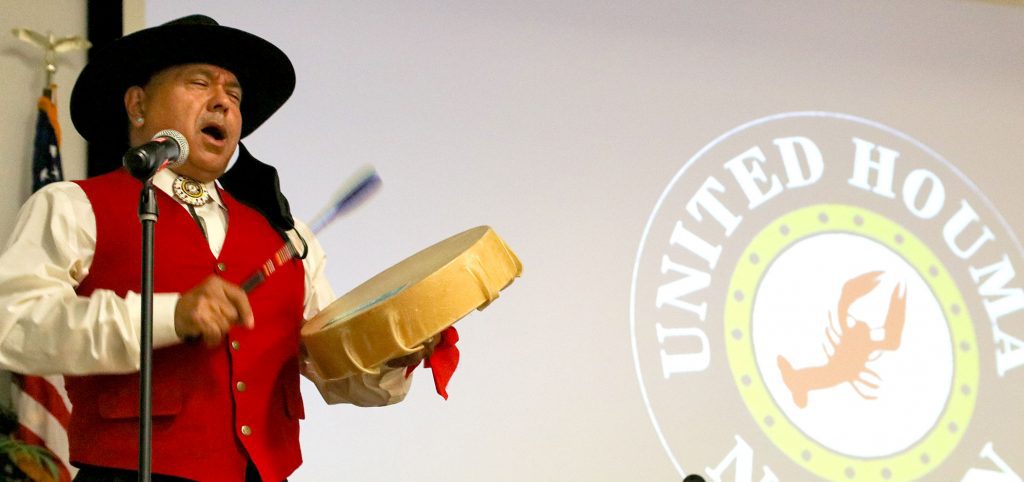
By Jade Williams, features editor For the United Houma Nation, music represents history. The songs of the tribe are about the lands and the waters. They are also about tribal leaders who were here long ago. “Some of the songs we sing are about the culture and about some of the stuff my people went through,” says August Creppel, chief of the UHN. “Most of the songs we sing though are Native prayer songs.” Some of the songs that the tribe sings are in English, Choctaw and some are in French. These songs are tribal songs that were passed down from elders. According to an article Ten Native American Music Traditions, singing is popular in Native American cultures and is integral to the storytelling purpose of many Native American songs as well as helping preserve Native American languages. Native American tribes all use the same instruments like drums, flutes, rattles and whistles, but the construction and sounds of their instruments vary. The drum is the oldest instrument and is significant to Native American music. “I use a hand drum, ” Creppel says. “We use big drums that we make out of different skins like elk skins We use regular keyboards and things like that.” Creppel says they play music with those instruments at ceremonies like weddings, before meetings and at powwows. He says that before the virus, there would be powwows held every March, but recently they had to shut all of that down. Creppel says he and his wife would also travel all over the country and go to festivals and culture centers, but all of that is also shut down. Outside of music being played at ceremonies, music has also had a huge impact on some of the tribal members when they were growing up. Roxanna Foret from the tribal council says she remembers delivering food boxes to people during Christmas time where she could smell the food and hear swamp pop music playing from people’s homes. “That for me, the old swamp pop music playing, just growing up, that is something that I remember a lot of like in a home like on Saturdays, just that type of music,” Foret says. “Or the French music. That’s something too on the radio. Like my grandpa, he would be up so early and the French music would be playing and there would be coffee brewing.” Lanor Curole, another tribal member who grew up in Golden Meadow, says she remembers waiting for the bus in morning as a child where they would listen to the KLEB radio station’s French program. “It was all French music and they only spoke French, and that French program would play every morning and they would do birthday wishes to people and it was so exciting if they wished you a happy birthday,” Curole says. “But that’s what we grew up hearing.” Curole says their people were traditionally stomp dancers and that there is some very distinct music that goes along with the ceremony stomp dancing. “Our people were traditionally stomp dancers and there are some very distinct music that goes along with the ceremony stomp dancing,” Curole says. “Our generation, that’s what we grew up listening to and hearing from our parents and grandparents.” chief creppel on hand drums PODCAST Dr. Gary LaFleur, Louisiana native and professor of biological sciences at Nicholls State University, discusses Isle Dernière before it became a popular resort.
Traditions Connect to Past

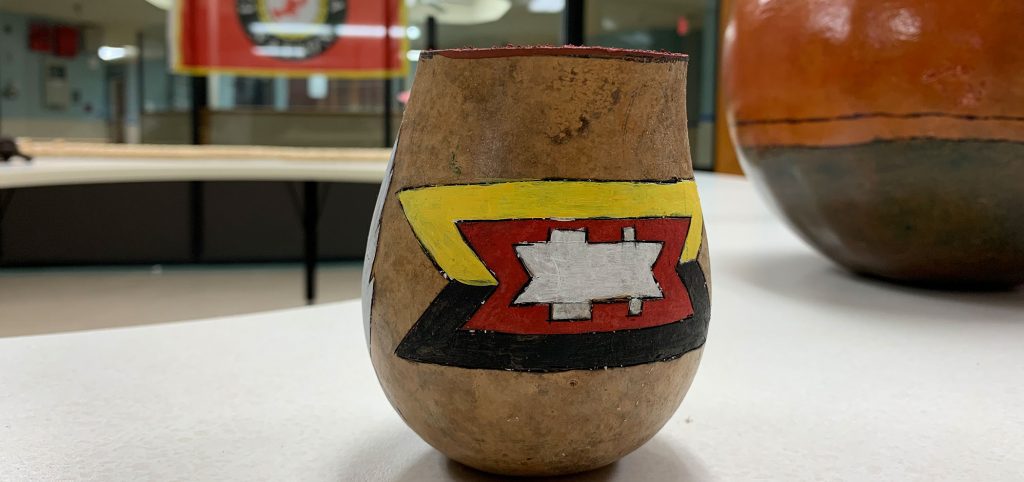
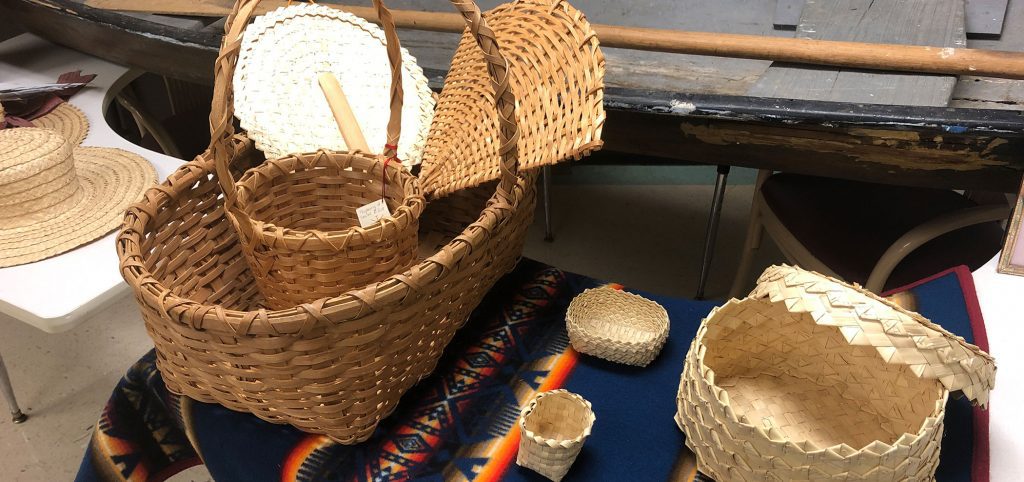
By Brendan Landry, staff writer The southernmost part of Louisiana is home to some of the most diverse people and traditions in the state. One group with many rich traditions is the United Houma Nation. The United Houma Nation is unique in many ways, from the songs they sing to the clothing they wear. The tribal citizens that make up this diverse group of people say they are proud of continuing the traditions of their ancestors like dancing, basket weaving, regalia design, palmetto hut building and bead crafting. Louise Billiot, a tribe member and traditional southern cloth dancer, says carrying on traditions connects her to her tribal history. “When I celebrate my tribe’s traditions, it reminds me of the history that has come before me,” Billiot says. One way the tribe keeps their traditions alive is at the annual celebration of traditions known as a pow-wow. The event brings together all of the tribal traditions into one big family-style event. “It is the heartbeat of the Indian people,” Billiot says. It allows tribe members to interact with one another and see displays of the member’s handcrafted jewelry, clothing, spears and dancing sticks for sale. Sometimes members will also build and display palmetto houses in the style of the past. “Before social media, it was how we got news from other tribes in the area,” says Kathleen Bergeron, an elder of the tribe. While some traditions are still practiced, some have also been lost over time. One tradition that has been lost is the traiteur or healer. Traiteurs would practice rituals to treat the ailments of the sick. They would often use plants such as Prell, a healing plant they believed could treat the sick. “Our parents couldn’t afford doctor bills, so this was the next best thing,” says Billiot. The traditions are a connection to the past, but also a way to show the tribe’s unique characteristics, says Charlie Duthu, a tribal citizen. “They have said that our people never existed, so it’s our job to show them that we were right here all along before anyone else.” United Houma Nation traditions Powwows Crafts Showcase Artistry Foods and Influences The Musical Backdrop
Membership

By brody gannon, staff writer Membership in the United Houma Nation is more than a title. It means more than the information printed on a tribal roll card. Becoming a member of the United Houma Nation is difficult, however. In 2014,tribal rolls were closed to all applicants over the age of five and the enrollment office only processes applications for enrollment from children of already enrolled tribal citizens, prior to the child’s fifth birthday, according to the United Houma Nation’s website. “Those Tribal Rolls were closed because we are pursuing federal recognition,” says Roxanna Foret, Tribal Councilwoman for district six. “In the eyes of the government, it looks suspicious for there to be huge influxes of people being added to our books. When we receive federal recognition, we plan to open our books fully to anyone who wishes to apply for membership.“ UHN enrollment staff maintain a database containing genealogical data of all citizens. “When our books are opened back up, if your parents are not registered as Houma citizens, you can track your ancestry to prove you have Houma blood,” says Vice Principal Chief Donny Verdin. Verdin says having an option for those who do not have registered Houma parents is important to be inclusive of people who did not have a family active in UHN affairs. The physical aspect of being a registered member of the UHN is important, but the emotional significance can have a far-reaching impact on people’s lives. “It means a lot to be a member of the UHN,” says Foret. “My dad and stepdad have always been involved with UHN activities, and it has just been a big part of my life. Actually, I almost care about it a little more because my two oldest children were not registered before they were five. I don’t want to take it for granted.” She wants to stay active among the UHN community and help receive federal recognition so her two oldest children can become registered citizens. “I was registered as a UHN citizen shortly after birth. We’ve had a lot of struggles, but our community is so beneficial to our members,” Verdin says. “Keeping our language and traditions alive gives hope that we won’t be forgotten in the future.”
Tribal Government

By hannah orgeron, staff writer Within the United Houma Nation, a system of government has been created. This system is not only important to keep the peace between the people, but it acts as representation for the citizens when they cannot fight by themselves. This system includes the chief, who is currently August “Cocoa” Creppel. “A government body within the tribe is very necessary,” he says. “You know we have almost 19,000 people spread out between six different parishes, and you have to have a good government representing each area and district so it’s very important to have a council of 11 people representing these areas. We come together to do what is best for the tribe.” Under the chief, the council then elects a vice principal chief, currently Donny Verdin. “Anyone can run for a position on the council,” he says. “In order to be a chief, you have to have experience being on the council though. We hold elections every four years and people run for the positions they desire. Both the chief and the council are elected to office every four years, but the chief can only do two terms. However, the council has no limit once elected.” According to the constitution of The United Houma Nation, within the government system there are different roles that make it most effective. Such as principal chief, vice principal chief, secretary, treasurer, parliamentarian, sergeant-at-arms, and the duties of committees or appointed officers. The positions of vice principal chief, secretary, treasurer, and parliamentarian are filled by citizens the tribal council nominates from within. However, the sergeant-at-arms and any other committee member are picked from out of the council and are not allowed to vote at Tribal Council meetings. Anyone can be on the Tribal Council as long as they are 25 years of age, reside in the district they are running for, have a high school equivalent diploma and do not have a criminal record. However, in order to run for chief one must be 35 years of age and have prior experience on the Tribal Council along with following all of the rules for being elected to tribal council. Tribal Council and chief positions are determined by majority vote. Creppel says he feels he is lifting his people up from the bottom, instead of being on top because he is chief. “I was told, you’re the chief, you’re on top, but I feel as I’m not on the top I’m on the bottom lifting my people up, not on the bottom holding them down,” he says. “I feel that it is my position to lift my people up whenever I can and to represent my elders to get them the representation for leading the way and also for our children who are our future.” PODCAST Chief Cocoa Creppel discusses the United Houma Nation government. Garde Voir Ci · Season 4, Episode 6 – Governing with Chief Cocoa Creppel The Lost Bayou · Season 4, Episode 11 – The Tribal Council with Jason Trosclair
Kasha Lacoban Clay

Houma, LOuisiana United Houma Nation Favorite Traditions “I would say community in general. There’s many assets of our community so I have and it all kind of links together at some point or another, but I have elders that I speak with, and even communicate with, and it’s on different levels. But sometimes I’ll be speaking with fishermen and sometimes I’ll be talking with youth within educational areas of interest and sometimes I’ll be working with artisans, bead workers, basket weavers, so just the type of place I am even a dancer. “So, I think overall, my favorite part is just the community and the wide range of different talents that people have and different lifestyles that we have within our tribe.” Being UHN “I hold my culture very close to my heart. It is something that I can tie back to my ancestry, where my people are from and learn from the struggles they’ve had throughout generations as well as see our growth in the future and the present. “So, it is not always the prettiest, you know, stories, but by owning up and knowing that’s my heritage, I can teach my kids and move forward from not the prettiest memories.” South Louisiana “I am really connected with the water, just the livelihood of living along the water is huge for me. “My dad has always been a fisherman of some sorts, he’s always been the provider of our home shrimping as well as hunting. He would be a seasonal worker. He would work on the shrimp boats during the shrimping season and he would be away from home hunting during hunting season. “Even when I was like a baby, he would work for skinning alligators at some point, and he also did oystering and he worked offshore shrimping as well, so I’ve always been really connected with our land here, but especially our water systems and that way of life.” Protecting UHN Land “I think that our biggest fear to protect and to continue the traditions is just that, to continue traditions and to show the younger generations the importance of our land and our water here. I know as time passes different occupations become more scarce. Like our people are not just normally fishermen anymore because it is not sustainable for their living anymore. “But at the same time, I think it is important to keep our heritage of being, living off of the land living off of the water, just being connected because I don’t want to lose that part of culture. “Losing that part of culture is also going to lose a lot of work towards sustaining the land and sustaining the water, because there is so many opportunities especially today for our youth and even those coming up right now into college to be able to work in coastal restoration, but I don’t feel like there is as much of a connection culturally that can really push the importance of it as it would have been back in the day.” Listen
The Challenge of Getting an Education

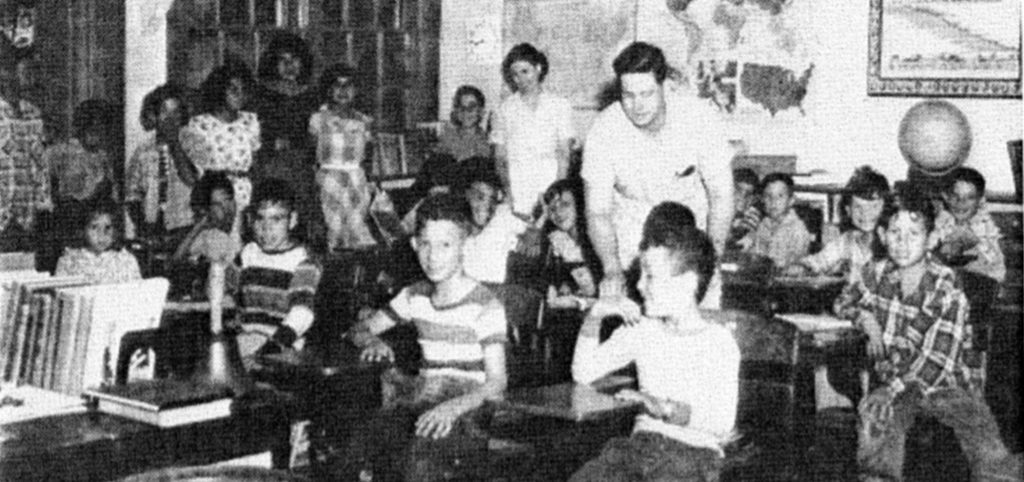
By hannah orgeron, staff writer Getting an education was challenging and complicated for the members of the United Houma Nation. “We weren’t treated right when I was growing up,” says Jeanette Billiot, a citizen of the United Houma Nation. “We were treated like outcasts.” Instead of being allowed to attend the parish’s main schools, the tribe was forced to open their own. Many of the schools were segregated and built from small houses. What is now known as the Montegut Community Center was an elementary school located in Montegut, Louisiana. The high school, known as Daigleville High School in Houma, didn’t open until later. Billiot, who attended the Montegut Community Center, says she started in first grade, but when she went to begin seventh grade, there was no teacher available. So she just did sixth grade again because she was not old enough to stop attending school. The Daigleville School served as a Native American-only high school for the students of Terrebonne Parish. According to the United Houma Nation’s website, segregation ended in schools in 1964 because of a successful lawsuit against the school board. Helen Duplantis, another tribal member who attended segregated schools, says there was some good. “One good thing was that we were able to speak the French language,” she says. “Other people couldn’t speak French at other schools. It was our primary language and we learned English from teachers.” To provide schooling during a time of segregation, the leaders in the Methodist church created a school for the Indigenous children of the area in an old dance hall, according to the “The Mission Story of the Dulac Community Center.” The first class was held in the building that is now the Dulac Community Center, on Oct. 1, 1932. The school soon became a place of community. It allowed clubs and groups to participate in things that were unique to their interest as well as a place to go when they needed support or friendship. In the end, Billiot says they forged their own educational path. “We do it our way and we do what we can.” PODCAST SERIES: a look at education within the United Houma Nation. Garde Voir Ci · Season 4, Episode 2 – Education with Charlie Duthu Garde Voir Ci · Season 4, Episode 3 – Education with Evelyn Jarrell Garde Voir Ci · Season 4, Episode 5 – The H.L. Bourgeois Legacy with Charlie Duthu an education Timeline 1840 First white school in Terrebonne Parish 1917 H.L. Billiot from Dularge filed suit against Terrebonne Parish School Board Lost – Appealed 1918 Supreme Court of Louisiana- Favored Terrebonne Parish School Board April 29, 1918 1922 Houma Methodist Church began educating Native Americans in Dulac 1930 Terrebonne Parish School Board opens adult illiterate schools and the first Indian School in Dulac 1932 Opened Methodist Mission School Mrs. George Deforest and Miss Wilhelmina 1936 Methodist Mission School expands to other bayou communities Mary Beth Littlejohn 1938 Terrebonne Parish Records show 262 Native Americans in school 1952 Indian school built on lower Pointe Aux Chene Children traveled by boat 1959 Indian students attend Daigleville School 1962 First Indian high school graduates 1967 School integration in pictures The outside of the Montegut Community Center. This is where Mrs. Jeanette Billiot attended school in the 1960s when it was an elementary school. She said it was only a few houses away from hers and that she would walk to school every day. This is where she attended 1st to 8th grade A class photo of the older class that attended the Golden Meadow Settlement School in 1951. Many of these people have yet to be identified in this picture. This picture is on display at the South Lafourche Public Library in Galliano. A class photo of the younger class that attended the Golden Meadow Settlement School in 1951. Just like the older class, many of these students have yet to be identified. This is on display at the South Lafourche Public Library in Galliano. Carl and Mildred Brunson (right) with the youth group that they established when they converted the Dulac Mission Center into a Community Center. They assisted in establishing more clubs unique to the interests of the students. They created a more diversified program for the community. The Mission Story of the Dulac Community Center PDF found from the Archives Bill Turner teaching a class at the Dulac Community Center. Bill and Relta Turner Started at the Dulac Mission Center in 1951 right out of college. Mrs. Relta Turner taught Kindergarten and first grade, and Bill taught 4th,5th,6th, and sometimes 7th grade. – The Mission Story of the Dulac Community Center PDF Younger students of the Dulac Community Center attending class. This photo was taken from Carl and Mildred Brunson’s photo album. Dulac Area 1953-1963 Older students of the Dulac Community Center attended class. This photo was taken from Carl and Mildred Brunson’s photo album. Daigleville School is located in Houma and is to be the future office of the United Houma Nations. The school was a Native American only high school during the time of segregation until 1964.
An Unspoken Language

By Madeleine Bauland, Staff Writer Language affects relationships and how people communicate. For the Houma, their language brings people closer together and strengthens tribal community ties. It is one of the biggest parts of their culture. The language of the Houmas, Uma, is part of the Western Muskogean family of languages and was unwritten. Since colonization, the community has spoken French and English. Reclaiming their language is vital to the Houma people because many of them have migrated and are not in their homelands anymore. They reside in all different locations across the United States and even globally. Because the language has evolved over time, it is important that the people of the Houma Tribe continue to hold on to it. Ben Wood, a member of the Houma Language Project, a group of volunteers dedicated to preserving Houma language, says language is tied to the tribe’s identity and those who speak it can feel physical benefits. It reduces stress levels, creates a healthier community and can help members achieve a better life outcome. “It definitely has a positive physical impact,” Wood says. There are also words in Uma and other Western Muskogean languages that have no English equivalent, he says. Those who still speak it are preserving the culture, and the deep meaning it holds is unlike any other language. Colleen Billiott, a member of the United Houma Nation and co-founder of the Houma Language Project, says that the work she does is important to her because of how it deepens her connection with family members whose example she learned from. “I am continuing to work off the foundation of what my pawpaw did for the tribe and what my great grandparents left behind like the recording of my great mawmaw, Elvira, singing in the Houma language” Billiot says. “That to me gives me so much meaning. That’s powerful. Being Houma, I know who I am, and I have pride in who I am.” The Houma Language Project Learn More PODCAST Hali Dardar, co-founder of the Houma Language Project, discusses language. Garde Voir Ci · Season 4, Episode 1 – The Houma Language Project with Hali Dardar Houma (Uma) words Black Blue Red White Additional Words One Houma: tcafa two Houma: toklu three Houma: totcenu four Houma: oshtu five Houma: tałape man Houma: atak Moon Houma: ashe Thank you Houma: yakuke see Houma: pesa eat Houma: apa woman Houma: oho sun Houma: ashe water Houma: oke hear Houma: haklu Hello Houma: aletu
Natural Medicine